Ingredients
Yields: 4 people
- 800 g pork belly - (get the ones with a clear 3-layer of skin-fat-meat; a 1:1:2 ratio of skin:fat:meat is what I aim for)
- 30 g lam yee (fermented bean curd)
- 8 g five spice powder
- 3 g pepper
- 1 l water
- 150 g coarse salt - for the crust
Method
Prepare the pork
- First, let’s get the pork ready for its journey to becoming the best siu yuk. Trim off any uneven sides of the pork belly, and pat it dry with kitchen towels on all sides, especially the skin. Then, with a skewer or a trussing needle, poke holes through the skin in a quick, stabbing motion. You should feel the skewer/needle puncture through the skin to form these tiny holes, but make sure it doesn’t go all the way through into the fat layer. Do this for 200 times, give or take. (I know this sounds like a lot, but it’s a really quick process, and it does make a difference!) In a small bowl, mix together the lam yee, five spice powder, and pepper. Then, rub this marinade on the meat sides of the pork (i.e. the bottom, as well as the four sides), leaving the skin completely free of marinade. Place the pork belly on a tray, and leave it uncovered in the fridge to dry out overnight for at least 12 hours, or up to 36 hours.
Ready the pork for roasting
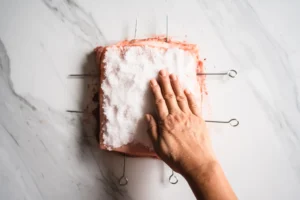
- Take your pork out of the fridge at least 30 minutes before you plan to roast it. Then, poke 4-6 skewers into the sides of the pork to ensure that the top surface of the pork is completely flat. (The skewers also keeps the pork from buckling during roasting.) Pour coarse salt onto the skin of the pork, and gently spread the salt all over the skin until you form an even layer, adding more salt if needed. You’ll know when you have enough when you can no longer see the pink of the skin underneath the salt.
Setup the oven
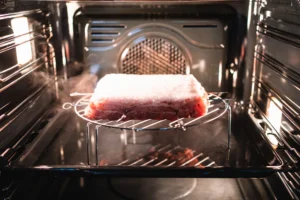
- Set a wire rack in the middle of the oven (this will be for the pork), and place a deep tray on the bottom rack of the oven. Heat the oven to 200°C (fan-assisted convection). Then, bring the 1 litre of water to a boil, and pour it into the bottom rack.
Roast the pork
- Place the pork on a wire rack and roast it for 45 minutes. Make sure that the bottom tray of water doesn’t run dry during the roasting process; so top it up with more boiling water if needed. After 45 minutes of roasting, take the pork belly out of the oven, and remove all the salt. The salt should have formed a crust that’s easily removable with a few gentle cracks. Make sure to brush away any straggling bits of salt that’s stuck to the sides too. Then, turn the oven up to 230°C and roast the pork belly for a further 40-50 minutes, or until the skin is completely crispy.
Slice and portion the pork belly
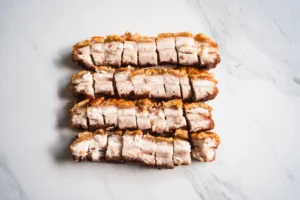
- When the pork belly is done, take it out of the oven and let it cool to room temperature before cutting. When cutting and portioning it, it’s best to flip the pork belly over and cut it from the meat side first. For a traditional siu yuk cut, slice the pork into long, 2cm thick strips, then chop each individual strip into 2cm x 2cm thick strips.
Eat!
- Now here’s the most difficult part of the process—control yourself from eating too much in one sitting. I’m kidding, there’s no need for control when it comes to siu yuk. Eat, and give in to glorious gluttony!